
Smitha had heard the rumours.
“Don’t step out after the sun sets.”
“Darkness is not your friend.”
Solvanta was a lush, green tropical island that flourished through the trade of a rare but exquisite fruit called the Lunaka. A vibrant, oval-shaped delicacy with a dappled orange-and-lime peel, it turned slightly soft to the touch when ripe. Inside, it revealed juicy, golden segments with a silky texture, tasting like a blend of ripe mango, pineapple, and a splash of coconut water.
The fruit grew only on the Yavana Trees—towering giants of the coastal jungles, with broad, sun-catching leaves and long, garland-like vines that twisted down from their branches. Islanders often ate the fruit fresh, chilled it in spring water, or mashed it into a thick, refreshing nectar.
Many had tried—and failed—to grow the fruit elsewhere, making Solvanta the sole source of this rare tropical treasure. Outside the island, the mysterious trees never bore fruit. And even if one appeared, it would never ripen. The unripe Lunaka was impossibly bitter and sour—completely inedible. Despite countless attempts, no one knew why the fruit refused to grow or ripen beyond Solvanta’s shores.
Fearing they might offend the gods who had blessed them with such a gift, the islanders remained cautious and private. Only fifty tourists were allowed each year.
This year, Smitha was among them.
Like any other tropical island, Solvanta’s beauty was mesmerising. The pearly white sand and the bluish-green sea were a sight to behold. There was only one guest house on the entire island where tourists could stay. Despite its modest size, the guest house offered exquisite rooms with sweeping views of the beach. Its restaurant served both native and international cuisine—meals enjoyed by tourists and locals alike.
But the beauty of the island masked a strange reality. The locals, wealthy from generations of fruit trade, lived lives of quiet leisure and contentment. Yet everything on the island shut down by 6 p.m.—before the last rays of sunlight touched the leaves.
Even Smitha’s windows were completely sealed, offering only a view of the dark sea. Like every other building on the island, the guest house was brightly lit at night—as though nightfall itself was unwelcome. Thick curtains helped her sleep better, but she couldn’t shake the unsettling thought: why did these outdoorsy islanders refuse to step outside after sunset?
The guest house had multiple locks installed, not to keep things out—but to keep guests from accidentally wandering beyond the safety of its walls. All visitors were expected to return by 5:30 p.m. sharp. If you didn’t, you’d almost certainly get a call from a panicked manager urging you to come in immediately.
Smitha could only wonder why. Despite asking multiple times, no one ever gave her a clear answer.
Once, she met a man named Aryan at a café. He had settled down on the island after marrying a local woman. He was the only one who gave her anything close to an explanation.
“You just shouldn’t,” Aryan said with a shrug. “Even my wife doesn’t know the full story, but she insists. If we want to go out at night, we take the ferry to the mainland and enjoy all the night-life we want. I’ve never really missed it.”
“But aren’t you curious?” Smitha asked.
“Nope,” he said, firmly. “Life gave me a beautiful wife, a luxurious life, and a happy family. I’m not about to poke around and risk it,” he added with a cheerful grin.
Then his tone changed—his voice dropped, his smile faded just slightly.
“But let me warn you,” he said, almost in a whisper. “One tourist I came here with once… he ventured out at night. That was the last I ever saw of him.”
After that conversation, something stirred in Smitha. She couldn’t let it go. She decided that she had to see the beach at night—just once. Not through a sealed glass pane, but with her own feet on the sand, the cool breeze brushing against her skin. She didn’t want to break the rules… but the mystery was too strong to ignore.
That night, she made up her mind—just one step outside onto the beach from her ground-floor room. The window, a sliding glass pane, had its handle removed to keep it permanently shut. But Smitha had already worked out a plan. Earlier that evening, she’d borrowed a piece of cutlery from the guest house restaurant and used it to turn the stubborn screw where the handle once was. It resisted—worn and aged—but eventually, the makeshift tool worked, and the window creaked open.
Once she was certain everything was in place, she waited. Eleven o’clock—the time when the island usually fell into a deep sleep.
Stealthily, she slid open the window and stepped outside. Behind her, she closed it again and turned toward the beach.
Even with her boldness, a quiet fear gnawed at her. Just in case, she wore a reversible jacket—dark on the outside, fluorescent on the inside—and carried a small backpack. Inside it were food, water, a torch, a lighter, insect spray, and a sturdy wooden bat. Smitha wasn’t reckless; she was ready.
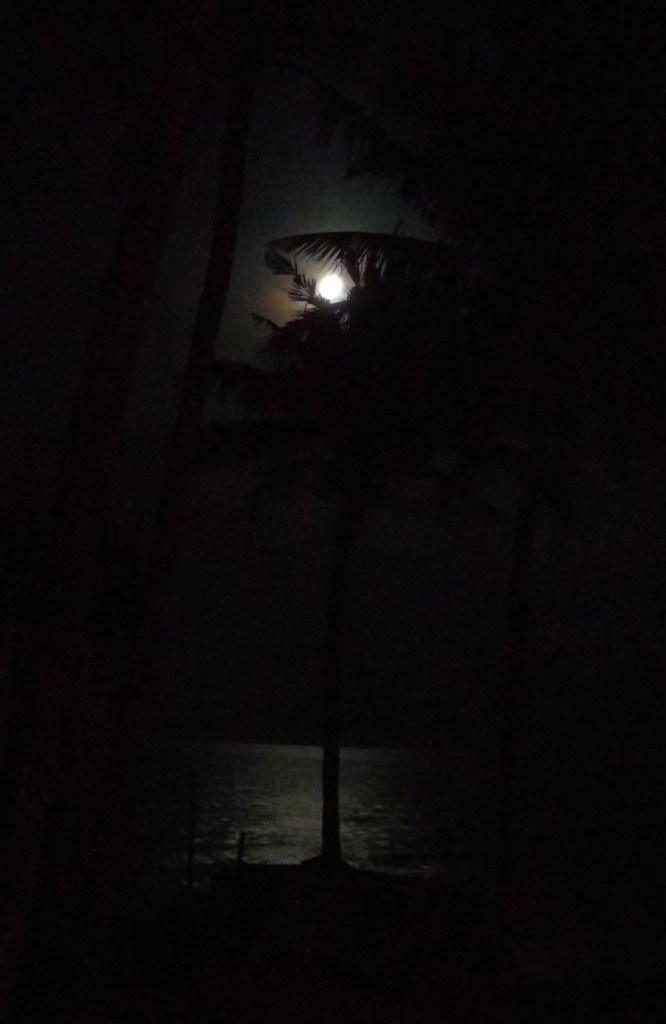
The guest house’s lights poured across the beach in a warm glow. The white, pearl-like sand felt soft and welcoming beneath her hands. The cool, salty breeze brushed against her skin and stirred her hair. Slowly, the fear that had clung to her melted into wonder.
Calmly, she sat on the sand, watching the dark waters splash rhythmically onto the shore.
After what felt like only minutes—though hours had passed—Smitha decided to head back to her room for a peaceful night’s sleep. That was when something caught her eye: a small trail she had taken countless times during the day. The one she loved. The one that began in grassy meadows and knitted its way through the towering green Yavana Trees, and eventually looped back to the guest house.
‘Well, it’s now or never,’ she thought, and turned towards the trail.
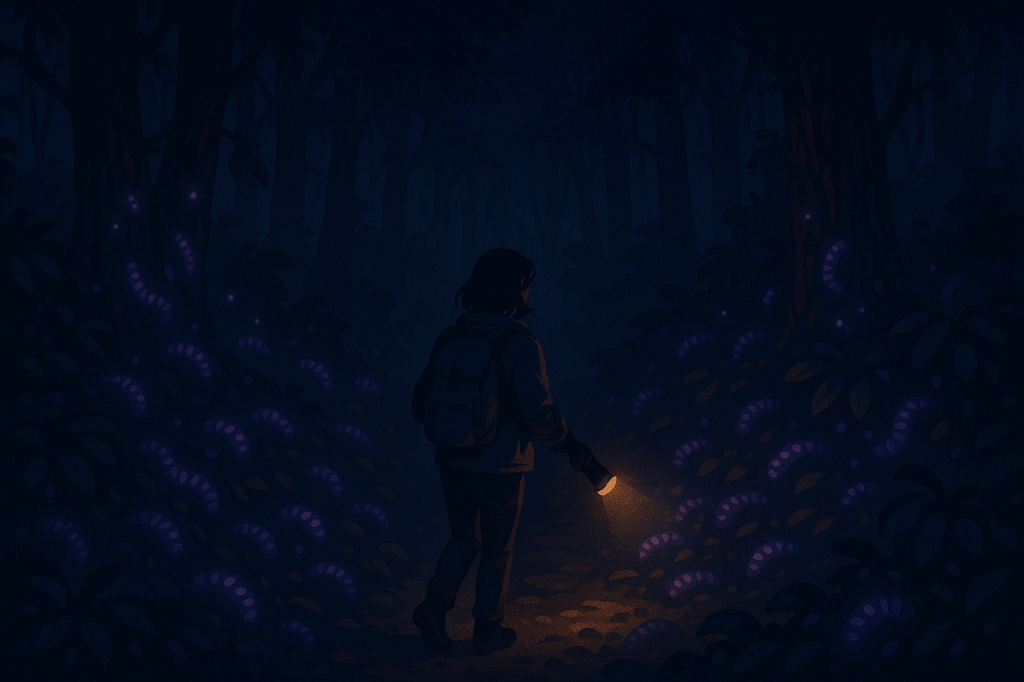
As she walked away from the brightly lit guest house, the glow dimmed behind her. The plants and everyday greenery of the tropical island began to surround her, cloaking the path in darkness. She pulled out her torch to light the way ahead.
Soon, she came to a small stream and crossed a wooden bridge—crafted from Yavana wood, its twisting vines naturally forming an arch overhead. Under the moonlight, the vines glimmered faintly, casting a silver-blue glow that made the bridge seem almost magical.
Then, she reached the Yavana grove—and her breath caught.
The trees were glowing.
A soft, bioluminescent purple shimmered across their trunks. It was unlike anything she had ever seen. Her torchlight felt intrusive now, so she switched it off. The natural glow was enough. Entranced, she walked deeper into the trail, the eerie beauty swallowing her whole.

But as she ventured further into the thick of the grove, something shifted.
The purple light… moved.
It slithered and shifted, not just across the trees, but along the forest floor. Curious, Smitha stepped closer. And that’s when she saw them—tiny, worm-like creatures glowing faintly in the dark. They were everywhere. Crawling up trunks. Creeping along the ground.
Then the silence hit her.
No chirping. No rustling. Nothing. Not even crickets.
An unsettling stillness hung in the air, pressing down on her like a warning. As an outdoorsy person, she was used to the comforting buzz of nighttime life. But here, in the heart of the grove, there was only silence.
Panic set in.
They weren’t just worms. They were leeches.
Frantic, she looked down at her shoes. The glowing things were crawling over them—some had already latched onto her legs. She staggered back, breath catching in her throat, as the nightmare began to unfold.
The leeches were growing.
Right before her eyes, the once tiny, glowing worms swelled in size, bloating unnaturally fast. Smitha’s breath caught in her throat as the realisation sank in—this was what had killed the others. This was why no one left their homes after dark. Why the beaches were considered safe.
Salt.
The creatures, monstrous as they were, still feared salt.
Without hesitation, she spun around. The sea—she had to reach the sea.
But the path back was swarming. The entire trail shimmered with that ominous purple glow. There was no way she’d make it back through that alive.
Then it struck her—sunlight!
Fumbling through her backpack, she pulled out the powerful torch she’d packed. It was designed to mimic the sun’s brightness, meant for emergencies in dense forests. She flicked it on and swept the beam across the path.
The purple glow vanished wherever the light touched.
She didn’t stop to check if the leeches were dead or just hiding. Instead, she ran. Because her life depended on it.
And she could feel it—that creeping, growing weight on her back and throat. Though she couldn’t feel any bites, the pressure was unmistakable. They were clinging to her, feeding.
She resisted the urge to claw at them. She knew better. Ripping them off could be worse.
Her breath grew shallow as she reached the edge of the trees and the first grains of sand beneath her shoes. The beach, bathed in the brilliant light of the guest house, shimmered like a haven.
And the glow on the leeches dimmed. They didn’t like the light.
But instead of rushing inside for help, Smitha made a split-second decision. She stripped off as much clothing as she could and dashed into the cold, dark sea.
‘May this not be the story of a goat escaping a jackal, only to end up in a lion’s jaws,’ she prayed silently.
The salt water stung—sharp, searing pain across her skin. But she welcomed it. Better this than dying in the forest.
She scrubbed every inch of her skin, searching for any signs of the leeches. To her immense relief, the salt seemed to have done its job. The creatures were gone.
Shivering and breathless, she dipped her belongings in the ocean too, soaking them thoroughly just in case.
Smitha slipped back into her room, locking the window behind her with trembling hands. Her soaked clothes and backpack sat submerged in a bucket of saltwater, as far from her bed as possible.
She reached out to the guest house staff for help. They didn’t ask her what happened. They just brought her a blanket. A cup of warm herbal tea. And a fresh Lunaka, gleaming golden on a porcelain plate.
As she lay curled under the thick covers, still burning from the salt, one of the staff gently said, “Rest. You’re safe now.”
She wanted to believe that. But her eyes drifted back to the Lunaka – Sweet, Juicy, Irresistible – Her stomach turned.
Because now, she understood why it could never grow anywhere else. The roots of the Yavana Trees ran deep. And the leeches—they never really died. They simply returned to the earth.
— The End —

 An Average Being
Leave a comment