Rishabh had always loved his birthday.
Even now, just a month away from turning twenty-three, he was giddy at the thought of his birthday. He loved the homemade cake and the laughter. He loved the way his mother would light the lamp before the celebrations began, murmuring some half-forgotten prayer under her breath. Birthdays, in their family, were always intimate affairs—woven with food, tradition, and stories that floated between generations.
This one was a bit different—special. In a few months, he’d be moving across the country for work, and life would scatter in all directions. Friends would be farther, family gatherings fewer. This birthday was tucked between summer breaks and grown-up goodbyes. It felt like the last one that would still be small and familiar.
That’s how he found himself travelling to his ancestral village for a short stay. A final summer of stillness before the whirlwind.
After weeks of bouncing between cities and continents, he returned to his roots. A week in his mother’s childhood home. It was nestled in a sleepy village called Pallipuram, where the air still smelled of damp earth and jasmine vines.
Just as he set foot into the house, he felt as though and old friend was waiting for him for his return.
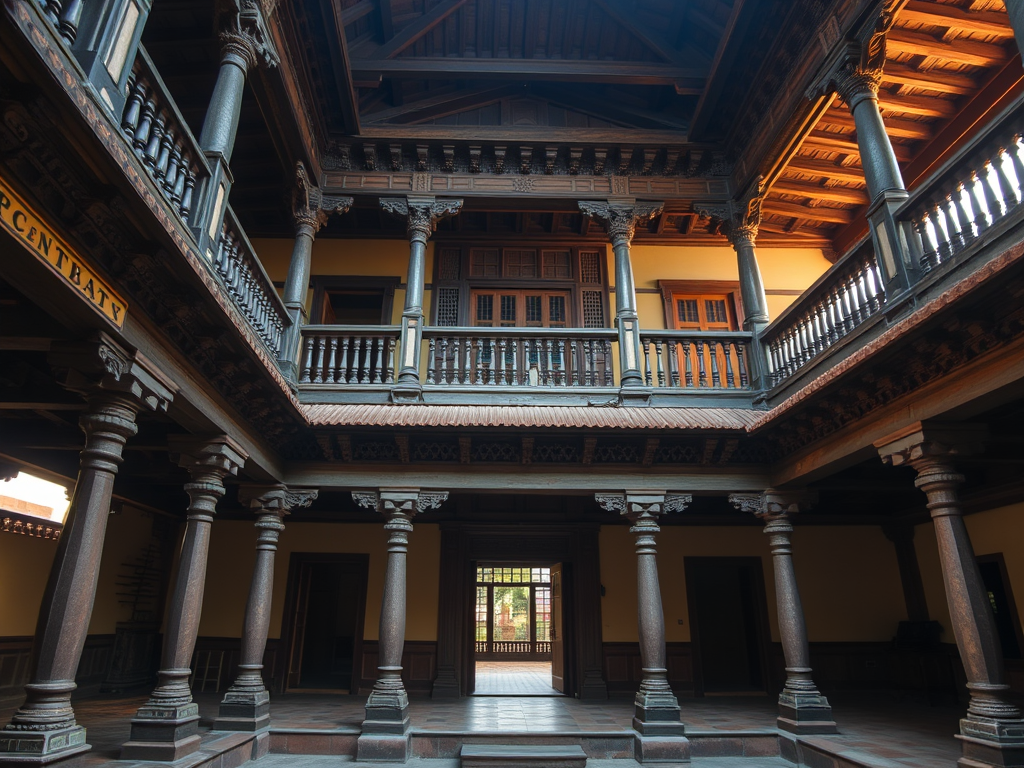
It was a sprawling home nestled at the edge of the village—a graceful balance of timeworn charm and careful upkeep. Teak wood pillars held up the central hall, tall and dark with the polish of generations. The red oxide floors had taken on a softness with age, worn smooth in the places people used to sit cross-legged. And in the centre, open to the sky, was a square courtyard where sunlight streamed down like a blessing.
Rishabh wandered barefoot through the house the evening he arrived, his fingers trailing across carved doorframes and cool walls. Though no one lived there anymore, a quiet caretaker named Kumar kept the place in impeccable shape. A few of the outer rooms were being rented out on Airbnb. It was mostly tourists who came for the peace, or artists in search of a muse. However, the heart of the house always remained untouched, preserved as it had been when his mother was a child.
The house didn’t need fans or fancy temperature controls. It was a thing of its time—sturdy, timeless, and full of stories.
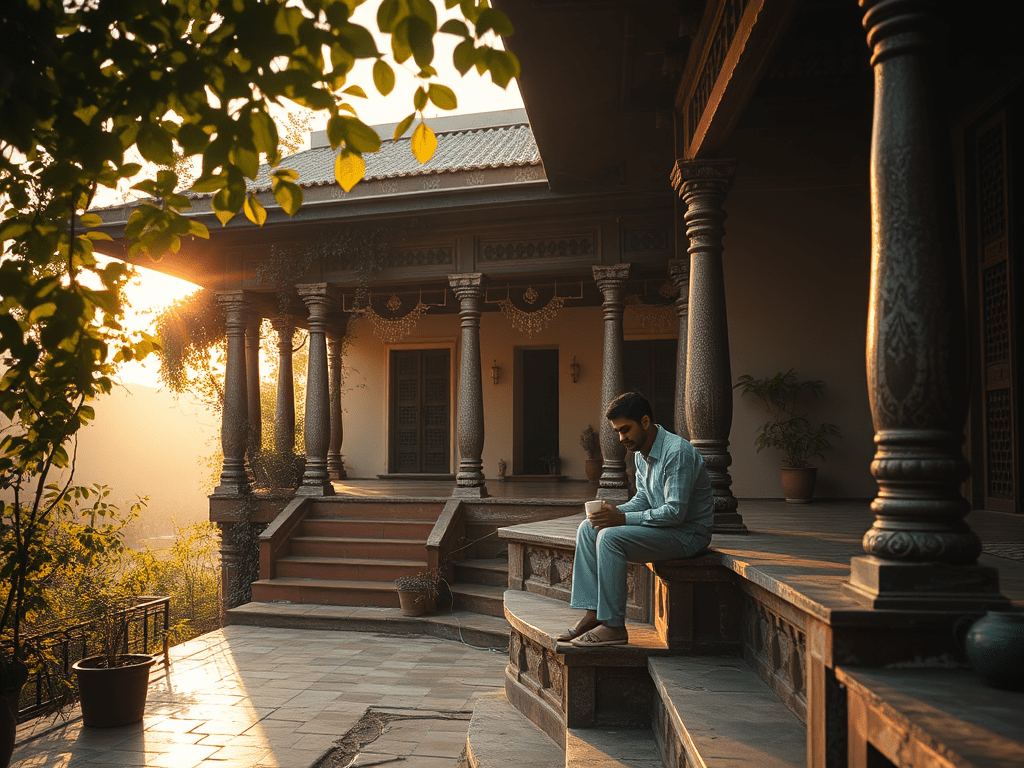
The mornings were his favourite. He’d rise early, sit on the stone steps with a tumbler of hot filter coffee. He would watch the light spill across the floor, chasing away the shadows from corners that always seemed to be watching.
On the third day, while looking for old board games in the upstairs cabinet, Rishabh found a stack of diaries tied with cotton string.
They were kept in a rusted tin trunk. It was stored behind yellowing curtains in a room that still smelled of sandalwood and camphor. His mother had once told him this room belonged to his great-grandmother, Lila. A woman known for her quiet strength and elaborate rituals, but one who never liked being asked too many questions.
The diaries were dated, labelled in careful cursive. He began flipping through old diaries, most were written by various family members. They were random entries, not meant for anyone else. Musings about village festivals, crop failures, neighbours getting married.
Of all the things in the trunk, there was the small, leather-bound book that caught his attention. Untitled. Unnamed.
Its pages crackled softly as he opened them—the ink had faded to the colour of smoke. The first few entries were uneventful. Notes about the house being painted. A recipe for pickled lime. A strange dream about a crow that spoke in riddles and some odd philosophical musings.
Then, near the middle, a short paragraph that didn’t fit with the rest.
“I tried to stop it. Even kept him inside the whole day. Locked the doors. But it doesn’t matter. It only needs a moment. A crack in the pattern. And then it finds a way.”
No name. No context.
The entry was dated 14 August, 1979.
Something about it made his skin prickle. That year rang a bell. He rummaged through a shelf nearby and pulled out an old photo album. One of the few that still had captions written in pencil.
There, between the faded birthday pictures and temple trips, was a sepia-toned photograph. A boy with a birthmark shaped like an inverted seven. Smiling. Standing beside a dog. Manoj, 1956–1979 was scribbled in the margin.
Rishabh did the math. He was twenty-three years old.
Something about the inverted seven bothered him—because Rishabh had the exact same mark on his left forearm.
He continued flipping through the album, uneasy now. A few pages later, he came across another photo. A young woman, barely older than him. Candidly smiling, caught mid-laughter, a fresh red dot of kumkum still bright on her forehead. She too had a birthmark on her hand. Almost instinctively, he flipped the photo to check the back.
“Age 23,” it read faintly. No name. No year.
He frowned.
Two family members from different decades. Different branches of the family. And yet…
The thought itched at the edges of his mind. He pushed it away that night, trying to chalk it up to coincidence.
But the next morning, something in him stirred—a quiet urgency he couldn’t ignore. He needed to know more. This time, he climbed into the attic.
It was his favourite part of the house—the scent of old paper, dust, and wood polish. A place where forgotten stories sat waiting to be found again.
He began his search, combing through wooden trunks and dusty shelves. Some books were diaries, older than even his great-grandmother’s time. Many were filled with loopy Tamil script describing mundane days—temple visits, monsoon harvests, minor squabbles with neighbours.
But to his surprise, some diaries were written in English. A few even in French.
He paused, silently marvelling at his family’s history. A well-travelled, well-educated lineage—even a century ago.
Tucked between the pages were old photographs—some so worn the faces had nearly disappeared. But the entries didn’t lie. A name here. A vague accident there. Each time, the age was the same.
Twenty-three.
And just like that, it no longer felt like a coincidence.
Everyone in the family lived long, unremarkable lives—except for the ones who didn’t. Accidents, yes. But always at the same age. Always just one per generation.
An eerie pattern was beginning to take shape.
Rishabh spent the rest of the afternoon sorting through the attic’s treasures. He piled every mention of untimely deaths, old photographs marked “Age 23,” letters that hinted at mourning too early, and fragments of faded newspaper clippings. He carefully bundled it all and brought it down to his room. He spread the papers across the floor like a puzzle waiting to be solved.
Still unsettled, he sought out Kumar, the caretaker.
“Do we have anything more official? Like a family tree or records?” Rishabh asked, trying to keep his tone casual.
Kumar thought for a moment, then nodded. “There’s an old family register. Your great-grandmother had it maintained meticulously. Come, I’ll show you.”
He returned with a thick, leather-bound book wrapped in cloth and smelling faintly of mothballs and ink. The first few pages were in exquisite calligraphy, complete with hand-drawn illustrations of ancestral homes, family mottos, and crests. With Kumar’s help, Rishabh traced his maternal line back not just decades—but centuries.
They were always educated. Always wealthy. Always living far beyond the expected years, even during eras when plagues swept through villages and the nearest doctor was a day’s journey away.
But one thing stood out.
Every generation had one name marked with a simple star, always accompanied by the words
“அவசர மரணம் – வயது 23” (Untimely Death – Age 23).
That evening, a strange memory struck him—something his mother once mentioned in passing. That many of the family’s older artefacts and delicate artworks were moved to a preservation vault in a heritage museum a few towns away. With little hesitation, he packed the attic evidence and left early the next morning.
The vault was more impressive than he’d imagined. Cool, temperature-controlled, lined with archival shelves and protected displays. A staff member helped him locate his family collection.
And there at the centre it stood—the oldest record of his family.
An oil painting of an ancestor—stern-eyed, richly robed, standing tall. But next to him stood a second figure. Hooded, faceless, hand resting lightly on the shoulder of the ancestor as though guiding him… or claiming him.
Rishabh had seen this painting before. He had always assumed it was a bodyguard or attendant. Now, he wasn’t so sure.
In the painting, the ancestor held a scroll—its seal unmistakable. A wax imprint shaped like an inverted seven.
Rishabh’s breath caught.
The inventory confirmed it: the scroll in the painting had been preserved. It was labelled simply “Family Poem – English Translated.” It was written in formal Tamil script, curved and flowing like waves.
They gave him a copy.
He sat down to read it, heart pounding. The museum had provided an English transliteration beneath the original.
Original (Tamil):
ஆழ வேரூன்றும், அழியா இல்லங்கள்
மறைமுக நண்பன் தருவான் செல்வங்கள்.
உறவோர் தோட்டம் என்றும் செழிக்கும்,
சில மலர்கள் பகல்முன் உதிர்க்கும்.முகம் தெரியாத அருள் வரும்போதெல்லாம்,
மூடிய கதவு திறக்கும் ஒரு வருடம்.
இந்த பேழையில் உள்ளது உடன்படிக்கை,
மாலையின் முத்தம் காலை வாரிசுக்கே.
Translation:
The Roots grow deep, and the homes endure
A shadowed friend bears fortune’s cure
The orchard of kin shall ever bloom
Yet some bright buds fade before noonA faceless grace visits now and then
A shuttered door opens in a certain year
This casket holds the pact once made
A kiss of dusk for morning’s heir
The weight of the lines fell heavy on Rishabh’s shoulders. It wasn’t just a poem. It was a contract. And the seal that marked his own skin was not a coincidence. It was a signature.
Devestated, Rishabh for his home. The one where his family lived. He wanted to spend the last few days with the ones he loved.
In his room, the scroll lay crumpled beside his bed, the photographs tucked beneath his pillow like talismans—useless and heavy. He stared at the ceiling through hours and shadows, unable to sleep. The walls that once warm with memory, now felt like a tomb.
He kept staring at the mark on his arm—that cruel, inverted seven.
One evening, just as the sun dipped below the courtyard square, he stood up. Slowly, deliberately, he walked to the bathroom. Picked up the shaving knife from the drawer. And with a shaking breath, he pressed it into the mark.
It was not a deep cut—but it was angry. Enough to bleed. Enough to scar. Enough, perhaps, to be seen.
Days went by since this day. The blade had long been cleaned.
Now, sunlight streamed gently through the slatted window, casting lines across the floor. The marbled tiles, once cold beneath his feet, now felt warm with the afternoon heat.
Rishabh sat quietly, his hand bandaged and resting on his lap.
His mother joined him with two cups of tea in hand. She placed one beside him but didn’t speak for a while.
Then, softly, “You know… Ramesh chithappa, your distant uncle. He died of a heart attack. Sixty-five. A peaceful end, but too young for a healthy man. I think the recent loss in his business put him in an overdrive.” After a pause, his mom continued, “We should visit their family today.”
Rishabh didn’t respond. He simply nodded, the movement small. Barely noticeable. His eyes fluttered shut, face unreadable. A single tear slipped down his cheek, silent and slow.
Had he broken the contract? If he had… what now? What would become of the others?
— The End —

 An Average Being
Leave a comment